While you are a student in the US there are a few key documents that you should understand, and will also need to be prepared to provide to other organizations like future employers, the MVA (Motor Vehicle Associate, for a driver’s license), and SSA (Social Security Administration, for your Social Security Number which you need to be paid to work in the US).
The most common documents you will need to use are your:
- Passport
- Visa
- I-20
- I-94
If you are employed in the US, you will also complete an I-9 document for each employer you work for.
Read more about the details of your individual documents in this section, so you can make sure you understand the information each one contains.
Passport
Your passport allows you to travel outside of your country, as well as return home again. Please keep your passport in a safe place, and do NOT carry your passport with you in the US. IES recommends carrying a photocopy of your passport with you.

F-1 visa
Your visa stamp is what allows you to enter the US. The kind of visa you have indicates what your purpose is in the US. In this case, your F-1 visa shows that your purpose in the US is to be a student. When you enter the US, your I-94 Entry/Exit record will assign you an immigration status based on your visa type – in this case, F-1 status.
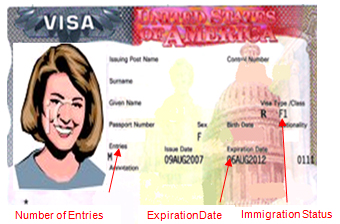
The visa stamp includes your personal information, where the visa was acquired, what kind of visa it is, when it expires, and how many times you can use it.
Most students will receive “M” under the “Entries” section, which means “Multiple” entries. In other words, as long as the visa dates are valid you can use it as many times as you like. Occasionally students will receive 1 or 2 entries per visa, though this is rare.
F-1 Visa Expiration and Renewal
Your visa stamp allows you to enter the US, so once it is expired you can no longer return to the US with that visa. However, it is NOT a problem if the visa expires while you are in the US. The visa’s purpose is to allow you to enter the US – once you are here, your I-20 and I-94 are what determine your immigration status. This is similar to going to a concert or movie – your ticket is very important to enter, but after you enter the building, you don’t really need the ticket anymore. Your visa is kind of like a ticket to enter the US.
There is no limit to the length of time you can be in the US with an expired visa, as long as your I-20 and I-94 are valid.
If your visa has expired, you will need to renew it after you leave the US next, but before you return to the US. There is no way to renew your visa in the US – this can only be done at a US Embassy outside of the US. This does not necessarily have to be at the Embassy nearest your home. Many Embassies welcome “third country nationals,” which are individuals that are not citizens of the country they are applying for a visa to enter, and are also not citizens of the country they are applying for the US visa in. Some UMBC students will take a trip to Canada, for example, to renew their visa. Please note you should be aware of entry requirements to any country other than your own – you may need a visa to enter that country as well.
Why do different students have different amounts of time on their F-1 student visa?
The length of a visa is determined by the “reciprocity rule.” This means that the US and your country agree on a mutual amount of time that citizens of each country can get different kinds of visas. You can see a table of the maximum length of time available for each visa category for citizens of different countries here.
While typically students in the F-1 visa category are given the maximum amount of time, regardless of long their I-20 is, this is not always the case. The nature of the student visa category is that your plans can change – after completing one degree, you might go on to work on OPT, or you might start a new degree at another school, for example. Thus, most of the time applicants for a student visa in the US will get the full amount of time available for someone from their country, even for a visa renewal. However, the consular officer conducting the interview has the ultimate decision and may occasionally choose to only make your visa for the length of time on your I-20 or another, shorter amount of time, though it is not clear what the factors for this decision might be. In general, students will receive the maximum amount of time possible for someone from their country on an F-1 visa.
I-94
The I-94 document serves two purposes:
- It is your entry and exit record of your time in the US. This means it documents when you first enter the US, and when you then leave after your stay in the US.
- It assigns you a category of immigration status, based on your visa type. This status will determine the rules you need to follow while you are in the US. For students, you will have F-1 status, and will need to follow the rules that are specific to international students.
You receive an I-94 when you enter the US, and it closes when you leave the US. Every time you enter the US, you receive a new I-94 with a new I-94 number on it.
Accessing Your I-94 Record
Your I-94 is available online AFTER you enter the US. You can look up your I-94 record here. You will be asked to provide your name, birthday, passport number and country of citizenship. Once your document is located, you will receive a form you can print for your records if you like.
The “Get Travel History” option will provide a page that will summarize all of your dates of arrival to and departure from the US, including the airport or location.
Please note, the “Admit Until Date” should always say “D/S” for F-1 international students. D/S means Duration of Status, which means you are welcome to stay in the US as long as your I-20 is valid. Other statuses will likely have a date, and the individual must leave the US or extend their status before that date.
The “Expiration Date” at the top right of the form is NOT your personal expiration date – this refers to the draft of the form, and is for use by government officials only. It does NOT affect your status in the US.
Sample:

Can’t Find your I-94 Record online? Is Your I-94 Information Incorrect?
First, please be sure to format your name as it appears on your visa, which may solve the problem. If you still can’t locate your record online, this means that an error was made on your I-94 when you entered the US, and needs to be corrected. This is not a bad thing, but does need to be fixed.
To have your I-94 record located and corrected, you will need to visit the nearest Customs and Border Protection (CBP) office. CBP is the organization that manages the I-94 system, and checks your documents when you enter the US.
The nearest CBP Office is BWI airport, about 10 minutes from campus. You will need to visit the Office in the lower level of the International Wing of the airport. UMBC Transit offers shuttles to the airport occasionally, or you can take a taxi or have a friend drive you. If you need to contact CBP at BWI directly, you can call them at 410-865-2100.
As of August 2026, CBP is open for I-94 corrections Mon – Thurs, 11am – 3.45pm
For the most up-to-date information, visit the CBP Deferred Inspection page CBP Deferred Inspection page and scroll down to Baltimore.
You will need to take your Passport and I-20 with you.
Please let the ISSS office know if you have any problems.
I-20
Your I-20 defines the details of your F-1 status in the US. It includes your personal information, school information, academic program, source of funding, and start and estimated end date of your program. If any of the information on your I-20 is incorrect, please contact the ISSS office immediately.
Please be aware of your I-20 end date – if your I-20 expires inappropriately, this can cause many problems for your status in the US. If you need additional time to complete your degree at UMBC, it is possible to apply for an I-20 extension. Please meet with an OISS advisor to review your options.
Your “SEVIS ID” is located in the top right of the I-20 first page, and starts with N00… This is your unique ID within SEVIS (Student and Exchange Visitor Information System). Students do not have access to SEVIS, but ISSS staff have appropriate access to your record.
The third page of the I-20 is where any employment information will go in the future, for CPT and OPT authorization. The bottom of the third page has your travel signature, which must be valid anytime you are requesting reentry to the U.S.
Students can only have one SEVIS ID active in the US at any time, and only one school can see your record at a time. If you choose to later transfer to another school, your SEVIS record, SEVIS ID and I-20 will all be sent to the new school of your choice.
Replace Lost or Stolen Immigration Documents
First, it is important to always have copies of your important documents like your passport, visa, I-20 and SSN Card. This can be electronic or hard copies. You should not be carrying your SSN Card with you at all times.
The Department of State has provided some guidance on next steps when immigration documents are lost or stolen that we have included below:
File a Police Report
Go to the local police station and report your documents lost or stolen. If available, you will need to provide copies of the original documents. You will be issued a police report detailing the incident. Don’t forget to make an extra copy of the report for your own records. This is very important for getting a replacement visa.
Get a Copy of Your I-94 Record
This is available online here: I-94 Record You will need to enter your lost passport details and biographical information. Please note your I-94 record is a record of your entry to the US. This will not change when you get a new passport.
Report Lost/Stolen Passport to Your Embassy
Contact the local embassy or consular section for the country of your citizenship for information about the procedure to replace a lost or stolen passport. Most countries have Internet web sites with contact information.
Report your Visa Lost/Stolen to the U.S. Embassy or Consulate Abroad
To report your visa lost or stolen, email the Consular Section at the U.S. Embassy or Consulate outside the United States which issued your visa. Go to the U.S. Embassy or Consulate website to locate the email address and contact information. Be sure to include your full name, date of birth, place of birth, address in the United States, and an e-mail address (if available). Specifically state whether the visa was lost or stolen. If you have a copy of the passport or visa, scan and email this to the embassy or consulate. Otherwise, if known, report the category of visa, and the passport number from the lost/stolen visa.
If you have already reported your visa lost/stolen to the U.S. Embassy or Consulate, and then you later find your misplaced visa, then your visa will be invalid for future travel to the United States. Therefore, in that situation you must apply for a new visa at the U.S. Embassy or Consulate.
Applying for a Replacement U.S. Visa
Lost or stolen U.S. visas cannot be replaced in the United States. For replacement of a visa, you must apply in person at a U.S. Embassy or Consulate abroad. When applying for the replacement of a visa, you will need to provide a written account documenting the loss of your passport and visa. Include a copy of the police report.
Bank Documents
SSN
Request a New I-20:
Replacing a Lost or Stolen EAD:
Students on OPT and STEM OPT who have lost their EAD will need to apply for a replacement with USCIS. Further instructions are available here.
Identity Protection